

Robot-Assisted Surgical Systems Market to reach USD 45.45 Billion by 2035 at 14.3% CAGR
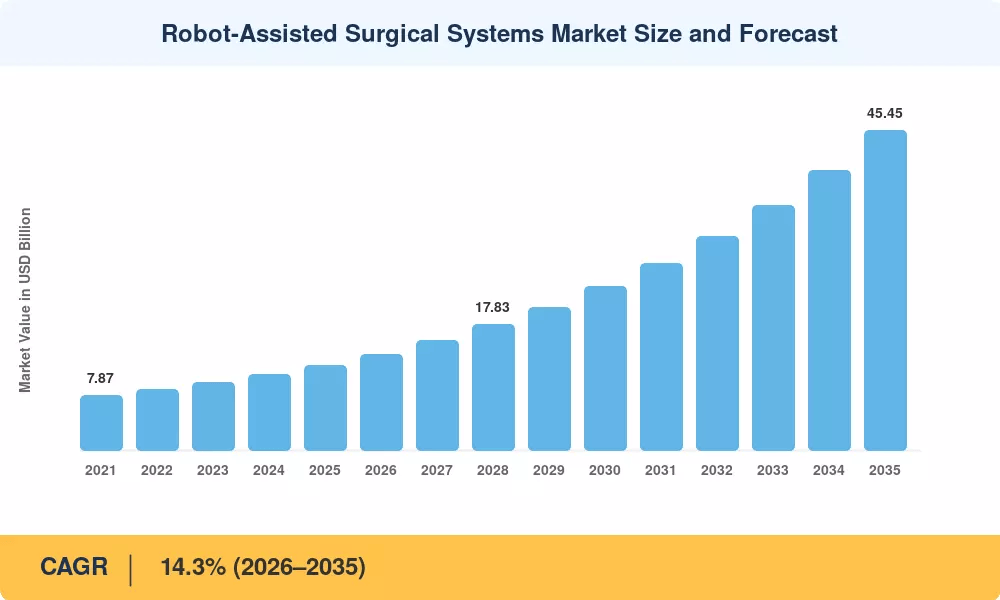
Robot-Assisted Surgical Systems Market Size
Robot-Assisted Surgical Systems Market to Surge from $13.65B in 2026 to $45.45B by 2035-By Outpatient Procedure Migration, AI-Enabled Intraoperative Guidance
NY, CA, UNITED STATES, July 6, 2026 /EINPresswire.com/ -- As per Market Research Future, the global Robot-Assisted Surgical Systems Market size to reach USD 45.45 Billion by 2035 from USD 13.65 Billion in 2026, at a CAGR of 14.3% during the forecast period 2026--2035. The market base was estimated at USD 12.04 Billion in 2025.The 14.3% CAGR---anchored by structural surgical demand rather than discretionary healthcare spending---is driven by three converging forces: accelerating outpatient procedure migration supported by expanded CMS ambulatory surgery reimbursement codes, sustained AI-enabled intraoperative guidance integration that has pulled robotic platforms from elective niches into standard-of-care protocols, and domestic Asian platform cost disruption that has compressed average selling prices by 25--40% while expanding addressable hospital populations.
National governments and multilateral health organizations are amplifying this momentum. The U.S. Centers for Medicare & Medicaid Services expanded the Ambulatory Surgical Center covered list by introducing 41 newly eligible surgical codes in 2024, boosting financial viability for specialized centers. The FDA implemented a three-tier autonomy framework in 2024 that established the regulatory pathway for AI-enabled decision support during procedures, with the top five vendors committing an estimated USD 1.2 billion in additional R&D within a year of its release. China's National Medical Products Administration cleared four domestically developed robotic platforms between 2023 and 2025, intensifying price competition across the Asia-Pacific region. Together, these initiatives are creating the procurement infrastructure and delivery innovation on which the Robot-Assisted Surgical Systems Market depends.
Request A Free Sample:
https://www.marketresearchfuture.com/sample_request/7777
Key Market Trends & Growth Drivers
Outpatient Procedure Migration and Extended Reimbursement
The Centers for Medicare & Medicaid Services expanded the Ambulatory Surgical Center covered list by introducing 41 newly eligible surgical codes in 2024, boosting financial viability for specialized centers. This regulatory integration supports the broader World Health Organization framework targeting global day-surgery infrastructure efficiency, lowering facility resource strain and redirecting soft-tissue volumes into lower-cost, high-throughput outpatient units. Hospital systems now justify seven-figure system acquisitions by demonstrating shorter average lengths of stay and measurable reductions in surgical-site infections, which third-party payers increasingly recognize in value-based contracts.
Extended survival in chronic disease populations---driven by an aging global demographic and rising prevalence of orthopedic and oncologic conditions---creates a larger prevalent population requiring sustained surgical intervention. Longer active lifespans transform joint degeneration and hernia repair from acute-event diagnoses into chronic management pathways with sustained robotic platform utilization. Early-adopter health systems report that AI-enhanced preoperative planning and intraoperative analytics reduce complication rates by 15--22% compared to conventional laparoscopy, converting patients who would previously have required extended inpatient stays into candidates for same-day discharge. Machine-learning models trained on over 3 million surgical datasets now predict optimal port placement and tissue resection margins with accuracy exceeding 94% in multi-center validation studies.
AI-Enabled Intraoperative Guidance and Digital Surgery Ecosystems
Legacy open-surgery equipment and standalone electromechanical platforms are giving ground to cloud-based, AI-enhanced robotic ecosystems. Multi-port and single-port robotic consoles with real-time tissue analytics capabilities are replacing outdated instrumentation. The FDA implemented digital health premarket evaluation metrics to validate software-as-a-medical-device platforms, mandating real-time structural identification and tissue analytics that establish a formal, compliant verification process for safety-focused machine-learning modules embedded directly within surgical instruments.
The convergence of diagnostic imaging with therapeutic robotic platforms is creating digital surgery ecosystems that personalize operative planning at scale. Novartis and Intuitive Surgical have committed over USD 2.5 billion combined in digital surgery infrastructure from 2022 to 2025. By 2030, an estimated 35% of newly diagnosed colorectal and gynecologic malignancy patients will undergo AI-enhanced preoperative staging followed by matched robotic-assisted resection, creating a diagnostic-therapeutic revenue loop. In the US, AI-enabled robotic adoption is accelerating as academic medical centers build cloud-linked analytics capacity and community hospitals deploy compact platforms for space-constrained operating rooms.
Domestic Asian Platform Cost Disruption and Value-Based Procurement
CMS's Oncology Care Model and its successor frameworks tie provider reimbursement to reduced length-of-stay and complication-rate metrics. European data from the OECD Health Statistics show that robotic-assisted procedures reduce average hospitalization duration by 1.8--2.4 days compared to open surgery, saving payers approximately USD 12,000--18,000 per patient. This economic incentive has driven hospital formulary committees to prioritize capital investment in robotic platforms, shifting procurement budgets toward the Robot-Assisted Surgical Systems Market at the expense of conventional open-surgery instrumentation spending. Value-based surgical contracts in the United States and European reference pricing for medical devices have shifted institutional procurement toward platforms with demonstrable outcomes data.
The move from capital hardware sales to subscription-based software and service models---as seen with Intuitive Surgical's ecosystem approach---decreases upfront acquisition barriers from seven-figure capital outlays to annual license agreements. Ambulatory surgical centers and community clinics are seeing a rising preference for per-procedure leasing arrangements due to lower operating costs and higher patient throughput.
Ask for Customization:
https://www.marketresearchfuture.com/ask_for_customize/7777
Market Segment Insights
BY PRODUCT TYPE
Systems: Dominant segment with ~62% revenue share in 2025. Reflecting the capital-intensive nature of platform deployments across hospitals and specialty centers. Surgical robots themselves represent roughly three-quarters of the segment value, with navigation systems contributing the balance. Hospitals typically depreciate system hardware over seven to ten years, creating predictable replacement-cycle demand that underpins segment stability. Hospital procurement teams treat multi-port consoles as default capital investments, and leasing structures have enabled broad adoption even in cost-sensitive emerging markets.
Software & Services: Fastest-growing product segment at 17.1% CAGR (2026--2035). Driven by subscription-based digital revenue models and expanding AI analytics integration. Vendors now bundle AI-powered analytics dashboards, cloud-based simulation training, and remote-diagnostics packages into annual license agreements, generating high-margin incremental revenue. The convergence of diagnostic imaging with matched therapeutic robotic platforms is creating digital surgery ecosystems that personalize operative planning at scale.
Consumables & Accessories: USD 3.13 Billion in 2025. Per-procedure instrument replacement mandates sustain residual demand. Single-use instrument tips, trocars, and energy devices generate recurring revenue that offsets capital-hardware margin compression.
BY APPLICATION
Gynecological Surgery: Dominant application with ~28% revenue share in 2025. Approximately 1.2 million annual robotic procedures in North America alone---spanning hysterectomy, myomectomy, and endometriosis resection---make gynecologic surgery a near-universal component of hospital robotic utilization. The inherent procedural volume and favorable clinical evidence base drive sustained dual-channel demand for robotic platforms.
Neurosurgery: Fastest-growing application segment at 17.5% CAGR (2026--2035). Reflecting stereotactic integration and image-guided navigation expanding clinical use cases. Recent regulatory clearances for AI-assisted cranial trajectory planning have expanded eligible case types beyond epilepsy and tumor biopsy into deep-brain stimulation electrode placement, creating a larger prevalent population requiring sustained robotic neurosurgical intervention.
BY END USER
Hospitals: Largest segment with ~49% share in 2025. Comprehensive surgical service lines and multi-specialty case mixes dominate volume. Hospitals remain the primary delivery site for complex robotic procedures due to radiation safety infrastructure, specialized waste disposal, and centralized procurement budgets. Large health systems increasingly negotiate enterprise-level agreements that bundle hardware, consumables, and software across multiple campuses.
Ambulatory Surgery Centers: Fastest-growing end-user segment at 17.9% CAGR (2026--2035). Outpatient shift and cost optimization drive demand as compact robotic platforms reduce the need for large operating-room footprints. ASCs and community cancer clinics increasingly prescribe robotic-assisted procedures to manage inpatient capacity and capture value-based reimbursement incentives. Compact robotic platforms designed for space-constrained ASC operating rooms are entering commercial availability, removing a key historical barrier to adoption.
Read Detailed Insights:
https://www.marketresearchfuture.com/reports/robot-assisted-surgical-systems-market-7777
Regional Outlook
North America -- Dominant Market (~47% Share, 2025)
The United States generates approximately 82% of North American Robot-Assisted Surgical Systems Market revenue, driven by the CMS Ambulatory Surgical Center expansion, commercial insurance coverage of robotic-assisted procedures as standard-of-care, and broad reimbursement for minimally invasive surgery regimens---a single policy ecosystem that converted an elective-surgery-dominated market into one with a structural preventive and therapeutic tail. CMS reimbursement for robotic procedures under the hospital outpatient prospective payment system has driven adoption in academic medical centers, while community oncology networks increasingly prescribe robotic-assisted outpatient options to manage operating-room capacity. The US dominates through a combination of high per-procedure spending, robust payer coverage, and rapid AI-enabled platform adoption.
Canada contributes through provincial health authority fleet modernization at 11.6% CAGR, while Mexico is growing at steady pace on medical-tourism corridor investment at USD 0.21 Billion in 2025. North America's leadership rests on reimbursement depth and the structural digital surgery segment created by expanded CMS compliance mandates and value-based surgical contracts.
Europe -- Second Largest (~24% Share, 2025)
Europe's Robot-Assisted Surgical Systems Market reflects divergent national strategies---Germany leads regionally with university-hospital network procurements, contributing 28% of regional share, while the UK historically used selective robotic targeting before broadening coverage through NHS Long Term Workforce Plan technology appraisals at 12.8% CAGR. France contributes ~18.5% of regional share through public-hospital modernization tenders. Italy contributes 11% of regional share on southern infrastructure gap investment. Spain is growing at 10.5% CAGR on regional health-service expansion.
Harmonization pressure from the EU Medical Device Regulation is gradually narrowing these differences, lifting baseline demand across the region. The European Commission's MDR mandates equitable access to advanced surgical technologies across all member states. The Nordic countries hold steady share on centralized procurement efficiency. Russia contributes 5% of regional share on import-substitution programs. Centralized health technology assessment bodies---NICE, G-BA, and HAS---have progressively widened reimbursement for robotic-assisted procedures across surgical disciplines.
Asia-Pacific -- Fastest-Growing Region (15.9% CAGR, 2026--2035)
Asia-Pacific is the engine of the Robot-Assisted Surgical Systems Market. China holds the largest regional share with ~34% of regional revenue, driven by NMPA domestic-platform clearances that compressed average selling prices by an estimated 25% across the region. India is growing at 17.2% CAGR on the back of Ayushman Bharat tertiary infrastructure expansion. Japan contributes USD 0.58 Billion through MHLW reimbursement code expansion at steady pace. South Korea is growing at 15.4% CAGR on MOHW surgical-robotics master plan.
ASEAN economies hold ~9.6% of regional share on medical tourism and public-private partnership hospital construction. The rest of Asia-Pacific is growing at 13.6% CAGR on early-stage adoption curve. The region's combined contribution anchors the global volume base for robotic surgical system demand. Asia-Pacific represents the highest-growth opportunity, driven by a confluence of rising surgical disease burden, urbanization, and government investment in tertiary surgical infrastructure.
Middle East & Africa -- Emerging Opportunity (USD 0.39 Billion, 2025)
The Middle East & Africa is bifurcated between well-funded Gulf states and resource-constrained Sub-Saharan nations. Saudi Arabia leads the region with Vision 2030 healthcare cluster development, contributing ~33% of regional share---NEOM health cluster and the UAE's Cleveland Clinic and Mayo Clinic affiliations have created pockets of excellence for robotic surgery. The UAE is growing at 14.8% CAGR on medical-tourism hub positioning. South Africa contributes USD 0.05 Billion on academic-center pilot deployments.
Egypt is growing at 11.3% CAGR on health-sector PPP frameworks. NGO-supported surgical access programs underpin demand across the rest of the region. Training infrastructure gaps in LMICs remain a restraint---real-world evidence from the FDA indicates that surgeon learning curves require 20--50 proctored cases before independent credentialing. These requirements lead to temporary operating-room throughput drops and physician reluctance to initiate early robotic programs, indirectly narrowing the Robot-Assisted Surgical Systems Market addressable population.
Competitive Landscape and Recent Developments
The Robot-Assisted Surgical Systems Market exhibits medium concentration, with the top five companies holding an estimated 58--64% combined revenue share. The Herfindahl-Hirschman Index sits in the 1,200--1,500 range, reflecting a mix of multinational medtech leaders and specialized robotic platform developers. Patent expirations and Asian challenger entry are gradually fragmenting branded segments, though ecosystem lock-in and installed-base network effects sustain competitive moats for first-movers.
The competitive landscape is stratified between multi-port ecosystem leaders serving global surgical markets, orthopedic-segment specialists capturing musculoskeletal robotics tenders, and domestic Asian manufacturers consolidating the cost-competitive segment.
KEY COMPANIES AND RECENT MILESTONES
Intuitive Surgical (2024--2025): Maintains leadership with the da Vinci 5 and Ion endoluminal platform, commanding ~22--26% of global Robot-Assisted Surgical Systems Market revenue. Ecosystem leader with a dominant installed base exceeding 5,400 systems in the United States alone. Premium platform positioning in specialty segments offsets price compression in competitive markets.
Medtronic (February 2026): Finalized the first commercial, multi-specialty soft-tissue procedure in the United States using its recently FDA-cleared Hugo robotic-assisted surgery system. Multi-specialty medtech integration anchors a strong global franchise, holding ~9--12% of global revenue.
Stryker (February 2026): Completed the first clinical cases utilizing THINK Surgical's TMINI Miniature Robotic System alongside Stryker's Triathlon Knee System under a joint distribution program. Mako SmartRobotics for orthopedics reinforces the pioneer in musculoskeletal robotics positioning, holding ~8--11% of global revenue.
Johnson & Johnson (2024--2025): Ottava multi-port platform in launch phase reinforces the broad surgical-portfolio leverage positioning, holding ~6--9% of global revenue. The company benefits from the structural digital surgery tail created by expanded AI-enabled platform investment.
Zimmer Biomet (October 2025): Acquired Monogram Technologies for approximately USD 177 million, integrating semi-autonomous, machine-vision-guided knee arthroplasty platforms directly into its portfolio. ROSA Knee/Spine/Brain platform reinforces the musculoskeletal-focused robotics positioning, holding ~5--7% of global revenue.
Future Outlook: 2026—2035
By 2030, precision digital surgery ecosystems will become the operating system of robotic-assisted surgical management. The convergence of companion diagnostics, AI analytics, and targeted robotic therapy will reshape the Robot-Assisted Surgical Systems Market through the late 2020s. By 2030, an estimated 35% of newly diagnosed colorectal and gynecologic malignancy patients will undergo AI-enhanced preoperative staging followed by matched robotic-assisted resection, creating a diagnostic-therapeutic revenue loop.
The FDA's three-tier autonomy framework ensures domestic AI-enabled platform supply scales alongside clinical demand. Machine-learning models that integrate genomic, proteomic, and imaging biomarkers can recommend optimal surgical approaches and postoperative care pathways for individual patients. Start-ups have raised over USD 800 million in venture funding for surgical decision-support tools since 2023.
Related Reports:
In Vitro Diagnostics Market - https://www.marketresearchfuture.com/reports/in-vitro-diagnostics-market-1165
Surgical Site Infection Control Market - https://www.marketresearchfuture.com/reports/surgical-site-infection-control-market-7830
Capillary Blood Collection Devices Market - https://www.marketresearchfuture.com/reports/capillary-blood-collection-devices-market-4213
Veterinary Diagnostics Market - https://www.marketresearchfuture.com/reports/veterinary-diagnostics-market-21729
Tattoo Removal Market - https://www.marketresearchfuture.com/reports/tattoo-removal-market-1701
Facial Fat Transfer Market - https://www.marketresearchfuture.com/reports/facial-fat-transfer-market-1780
Immunofluorescence Assay Market - https://www.marketresearchfuture.com/reports/immunofluorescence-assay-market-6177
Chondrosarcoma Market - https://www.marketresearchfuture.com/reports/chondrosarcoma-market-3629
Malaria Diagnostics Market - https://www.marketresearchfuture.com/reports/malaria-diagnostics-market-6432
Lice Treatment Market - https://www.marketresearchfuture.com/reports/lice-treatment-market-7134
Larry Wilson
WantStats Research And Media Pvt. Ltd.
+1 855-661-4441
email us here
Visit us on social media:
LinkedIn
Facebook
YouTube
X
Legal Disclaimer:
EIN Presswire provides this news content "as is" without warranty of any kind. We do not accept any responsibility or liability for the accuracy, content, images, videos, licenses, completeness, legality, or reliability of the information contained in this article. If you have any complaints or copyright issues related to this article, kindly contact the author above.
